
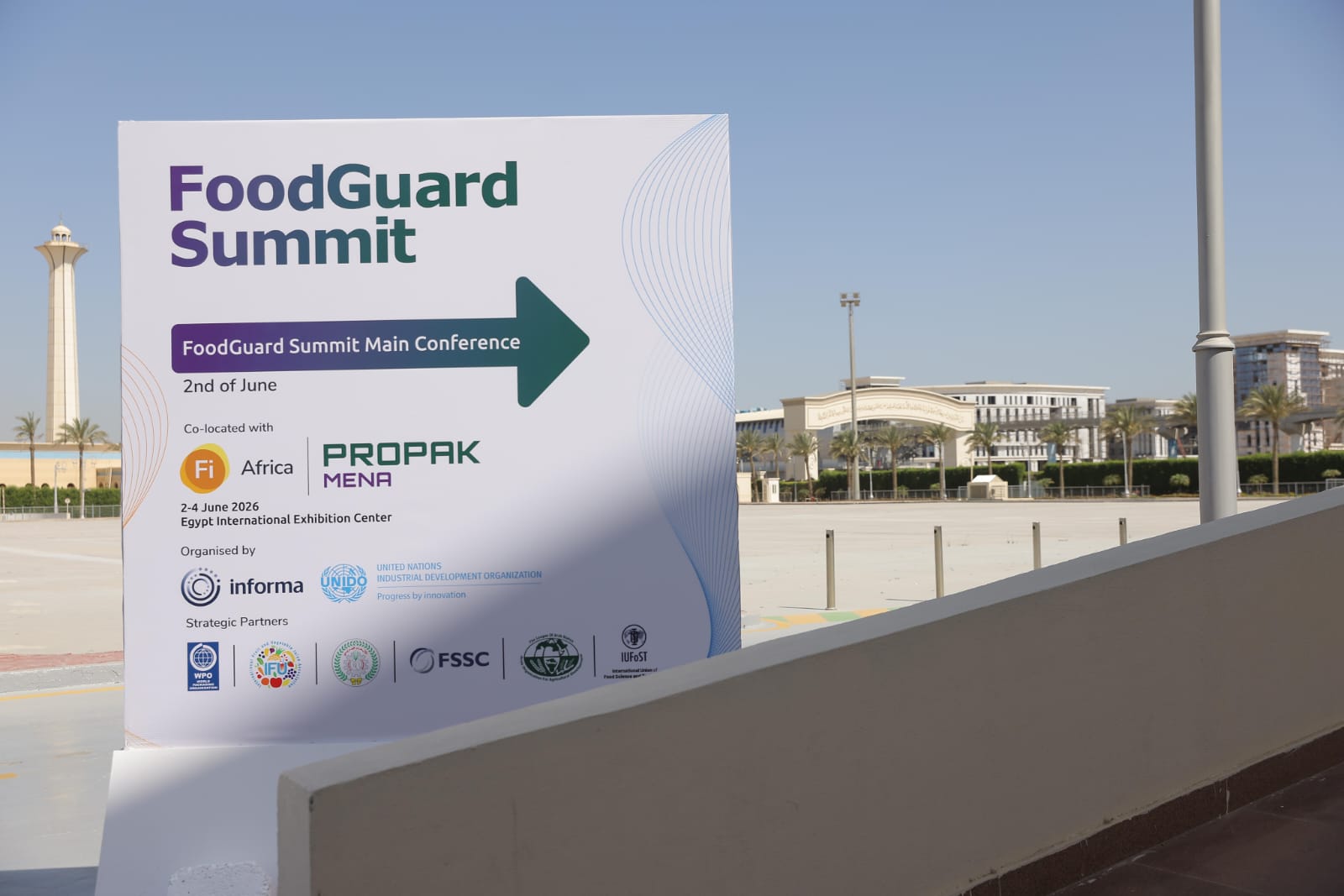
The inaugural FoodGuard Summit kicked off in Egypt on Tuesday, June 2, 2026, with the food waste crisis, particularly in Africa, taking center stage in the discussions.
The summit is organized by Informa Markets, a leading global events and exhibitions company. In cooperation with the United Nations Industrial Development Organization (UNIDO), the 14th edition of the Fi Africa and ProPak MENA 2026 exhibitions are being held in Cairo until Thursday, June 4, 2026.
The exhibitions and the FoodGuard Summit enjoy broad government support through the sponsorship of four ministries. Two of these ministries, Industry Minister Khaled Hashem and Supply Minister Sherif Farouk, participated in the opening, according to reports from Food & Climate, which covered the summit’s events.
The first session of the FoodGuard Summit addressed food waste in Africa
Eloise Peacock, senior analyst at WRAP, stated that the food waste crisis contributes to the growing problem of hunger in Africa. Speaking at the first session of the inaugural Foodguard Summit, currently being hosted by Egypt, she noted that each person wastes approximately 6 kilograms of food annually, along with about 45 gallons of water daily. It was used in irrigation and other production processes, according to several studies.
Ibrahim El-Dukheari, Director General of the Arab Organization for Agricultural Development, added that the organization is working on establishing a platform to reduce food waste.
He explained that this waste makes addressing food security issues less flexible, emphasizing the need to rely on scientific research to tackle this crisis. “We have several research papers on this subject,” he said.

Read also: Transformation from Single-Use Plastic to multi-use in Egypt, tow UNIDO officials explain the reasons for postponing the project awareness campaign to “Food & Climate”
Assane Ng’ Ombe, head of the “Re-Gain” program at the non-profit organization “Agra,” which operates across Africa, revealed that they have an initiative that began in 2024, which has successfully reduced food waste in several countries on the continent by 22,000 tons, equivalent to eliminating 86,000 tons of carbon emissions.
He pointed out that waste reduction measures can achieve significant success by increasing the necessary actions, as happened in Japan, which has halved its food waste since 2022 and aims to reach “zero food waste” by 2030.
The Wheat Waste Crisis in Egypt
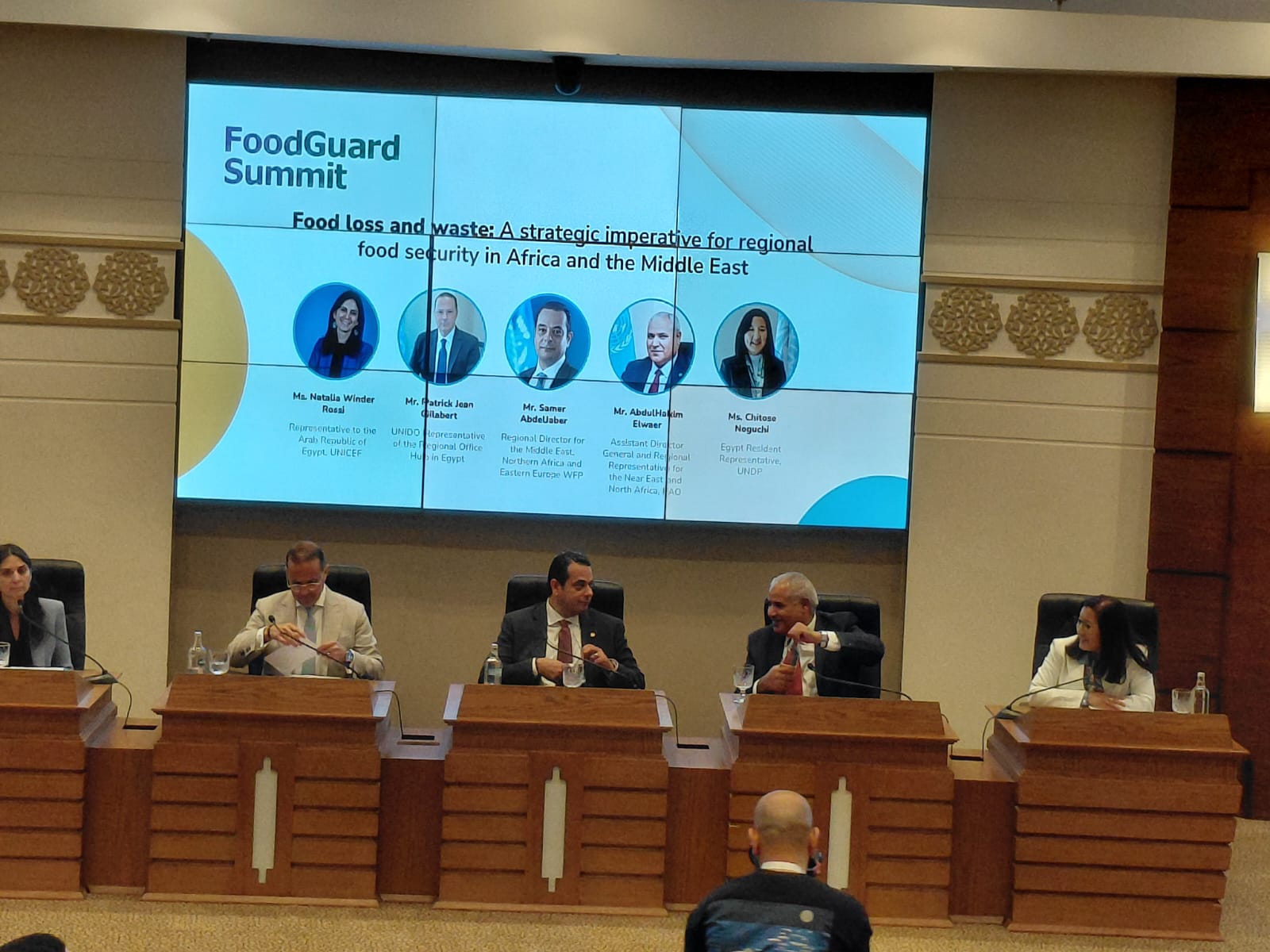
Chitose Noguchi is the UNDP Resident Representative in Egypt. stated that Egypt is one of the world’s largest wheat importers, with imports averaging 12 million tons annually. However, nearly 4 million tons of this is wasted, despite the country’s water scarcity and large number of marginalized groups.
During the second session of the inaugural FoodGuard Summit, which was launched in Egypt, she added that the effects of food waste extend beyond resource depletion to include environmental pollution.
The UNDP, along with other UN agencies, promotes initiatives to reduce food waste and build a circular economy, according to Noguchi.
Read also: Study: How can grocers cut food waste?
Natalia Rossi, UNICEF Representative in Egypt, said, “When we waste food, children and adolescents pay the price.” We are fighting two crises: ensuring children have access to nutritious food, and the food security that has been disrupted by this waste. Sadly, millions of children worldwide are not receiving adequate nutrition, and millions more are receiving only calories, not nutritious food.
84% of Food Losses in the WFP
Samer Abdeljaber, the WFP’s Regional Director for the Middle East, North Africa, and Eastern Europe, pointed out that 84% of food losses are due to the lack of suitable storage facilities in the region. “The Middle East and Africa are the most affected by food losses in the WFP, and as a result, 121 million people are suffering.”
He explained that the areas most affected by food losses are those experiencing conflict, such as Gaza, where infrastructure has been completely destroyed.
Syria also has the highest rate of food waste globally, exceeding the global average by approximately 23%.
Read also: Combating food waste in Africa
AbdulHakim Elwaer, Assistant Director General and Regional representive for the Near East and North Africa, (FAO), stated that food waste in the region exceeds the global average. He cited as evidence the fact that wheat imports in the Arab region average 36 million tons annually, of which approximately 16 million tons are wasted each year, at a time when the region is suffering from water scarcity.
Elwaer believes the solution begins with agriculture, citing sugarcane in Egypt as an example. While sugarcane is produced from sugar, the byproducts can be converted into compost.